Table of Contents
- Why the Best Trash Bin Cleaning Service Matters
- Trash Bin Cleaning Cost: What to Expect and How to Compare
- How Often to Clean Trash Bins: A Practical Schedule
- What a Trash Bin Sanitizing Service Actually Does
- Eco-Friendly Trash Can Cleaning: Water Use and Wastewater
- How to Choose the Best Trash Bin Cleaning Service
- Frequently Asked Questions
Last Updated: October 21, 2026
Why the Best Trash Bin Cleaning Service Matters
A trash bin is a warm, wet, food-rich environment, and in Texas heat it becomes a breeding ground within days. Kade Blast Pressure Washing handles these bins professionally across Spring and The Woodlands, and the smell is not the real problem, it is a symptom.
Trash bin cleaning is the process of emptying, washing, sanitizing, and deodorizing a waste container with professional equipment rather than a garden hose.
Bin cleaning is closer to pest and hygiene control than a cosmetic chore: residual food waste and liquid at the base of a garbage bin draw flies, roaches, and rodents, and runoff leaking onto your driveway carries that same material with it.
Trash Bin Cleaning Cost: What to Expect and How to Compare
Trash bin cleaning cost depends on how many bins you have, how often you book, and whether the provider charges per bin or per visit. The structure matters more than the headline number, so normalize every quote to the same unit.
Request current rates directly from the provider rather than trusting a directory listing; pricing changes by route, bin count, and plan.
Per-Cleaning Price vs. Recurring Plans
A per-cleaning price is what you pay for a single visit with no commitment. A recurring plan spreads the same work across a set schedule, usually monthly or quarterly, and typically costs less per visit.
A household that cooks most nights will hit real buildup in weeks, not months; a smaller household generating little food waste can stretch a quarterly schedule.
How to Normalize Quotes Into a True Cost per Bin per Visit
Providers quote in different units, so convert every quote to a single metric: cost per bin per visit.
- Count the bins you actually need cleaned. Most households have one trash bin and one recycling bin; ask whether the quote covers each container or only the trash bin.
- Divide the quoted total by the number of bins. A low quote for "two bins" may be a per-bin rate multiplied by two, or a base rate plus a per-bin surcharge.
- Divide by the number of visits in the plan term. A quarterly plan billed annually has four visits; a monthly plan has twelve.
- Add mandatory fees. Route fees, fuel surcharges, and setup charges belong in the total.
- Subtract included services you would otherwise pay for. If sanitizing and deodorizing are included, the effective cost per visit is lower than a cheaper quote that charges them as add-ons.
A low headline rate that excludes sanitizing, deodorizing, or a second bin is common; normalizing to cost per bin per visit exposes it quickly.
Hidden Costs to Watch For
The per-cleaning price is not always the total. Watch for:
- Per-bin surcharges on top of a quoted base rate
- Travel or route fees outside a provider's standard service area
- Add-on charges for deodorizing or sanitizing that should be part of the clean
- Cancellation terms on plans advertised as flexible
A provider quoting one clear number for a defined scope is easier to trust than one with a low headline rate and a stack of extras.
Questions That Reveal the Real Total
Ask these before comparing two quotes:
- What is the price per bin per visit, including all mandatory fees?
- Are sanitizing and deodorizing included, or priced separately?
- Is there a minimum number of bins or visits?
- Does the rate change for a second bin or container type?
How Often to Clean Trash Bins: A Practical Schedule
Most households do well on a monthly schedule, with quarterly as the minimum for smaller households. The right frequency comes down to volume, climate, and what you put in the bin.
| Household Situation | Suggested Frequency | Why |
|---|---|---|
| Family of four or more, food scraps in the bin | Monthly | Fast organic buildup in warm weather |
| Couple or small household, little food waste | Quarterly | Slower accumulation, lower odor risk |
| Recycling bin only | Quarterly | Rinsed containers still leave sticky residue |
| Summer months in high heat | Monthly or more | Heat accelerates bacteria and odor |
| Commercial or HOA shared bins | Monthly | Higher volume, more pest pressure |
Recycling bins get skipped constantly, and that is a mistake. A rinsed jar still leaves sugar and liquid residue behind, and that film attracts pests just as reliably as food waste.
What a Trash Bin Sanitizing Service Actually Does
A trash bin sanitizing service empties the container, washes the interior with heated water under pressure, applies a sanitizing agent, rinses, and deodorizes before returning the bin to the curb. Skipping the sanitizing step turns a wash into a rinse.
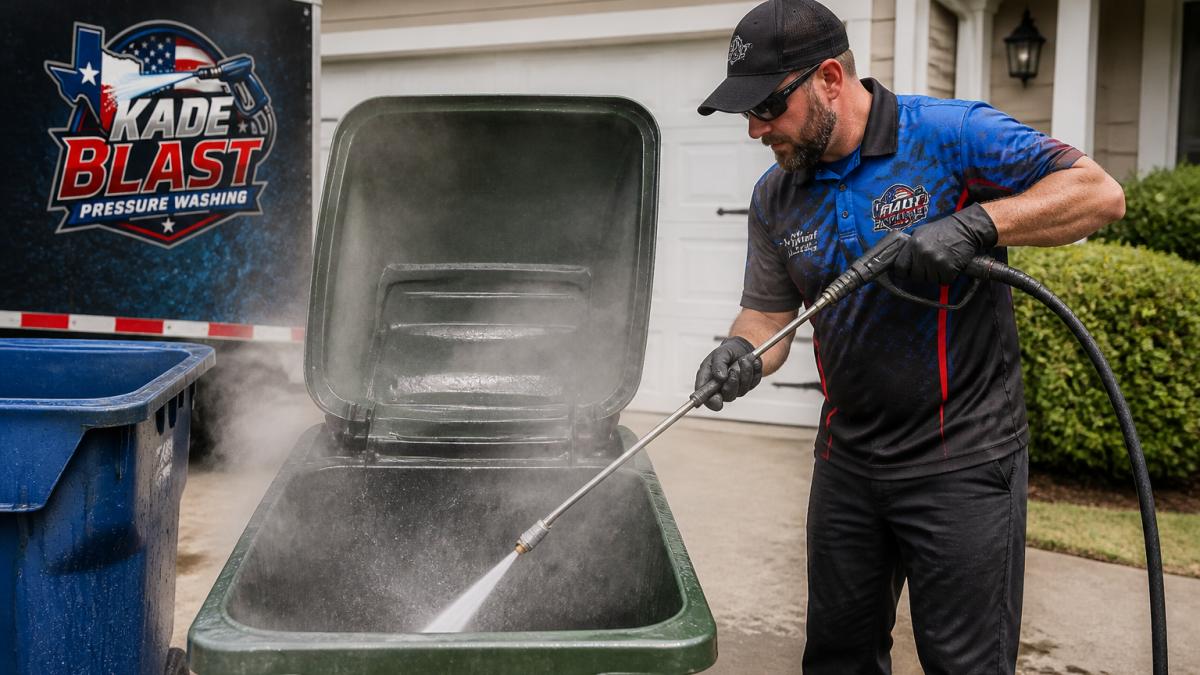
Here is the sequence a proper service follows:
- Empty and inspect the bin for debris, damage, and stuck material
- Pre-treat caked-on grime at the base and corners
- Pressure wash the interior with hot water
- Apply sanitizing agent to reduce bacteria on the surface
- Rinse away loosened material and residue
- Deodorize with a pet- and family-safe product
- Contain and dispose of the wastewater properly
Hot-Water Pressure Washing and Equipment
Hot water softens the greasy film that clings to plastic, and pressure lifts it off rather than smearing it around. A truck built for this work carries its own water supply and a containment system, so runoff is captured instead of running down your driveway. That containment is the detail to ask about, a provider using a pressure washer and a hose from a pickup will leave a wet, smelly trail behind.
How to Evaluate Sanitation Claims
Ask what the sanitizing agent actually is, and ask for the claim in writing. Any provider making a germ or bacteria reduction claim should name the product and explain how it is applied; vague language like "kills germs" without a product name or method is a marketing line. For pet owners, ask whether the deodorizer is safe around animals.
Eco-Friendly Trash Can Cleaning: Water Use and Wastewater
Eco-friendly trash can cleaning comes down to two things: how much water the process uses and where the dirty water goes. A truck-mounted system uses a controlled volume per bin and captures runoff in a holding tank; a garden hose uses far more water and sends everything into your yard or the gutter.
The deodorizer matters too. A masking agent covers odor temporarily; a proper pet- and family-safe deodorizer applied after sanitizing leaves nothing for bacteria to feed on.
How to Choose the Best Trash Bin Cleaning Service
The best trash bin cleaning service answers your questions directly, covers your address, and shows up when scheduled. Score providers on the same criteria rather than choosing whoever answers the phone first.
Run through this checklist before you book:
- Confirm the provider services your specific address, not just your metro area
- Ask for the per-visit price with no add-ons attached
- Confirm whether sanitizing and deodorizing are included or extra
- Ask how wastewater is captured and disposed of
A Side-by-Side Comparison Framework
Score every provider on the same five criteria to turn a subjective choice into a defensible comparison.
- Coverage confirmation. Does the provider confirm your specific address or ZIP code, not just your metro area?
- Total cost per bin per visit. Normalize every quote to the same unit, including mandatory fees and included services.
- Process and containment. Does the provider use hot-water pressure washing, apply a named sanitizing agent, and capture wastewater in a holding tank?
- Reliability signals. Look for reviews mentioning missed visits, late arrivals, rescheduling, and consistency over time, not just star averages.
- Customer experience terms. Confirm cancellation terms, damage policy, weather-delay policy, and what happens if bins are not accessible on service day.
A provider that scores well on all five is safer than one that wins on price alone.
Coverage Verification for a National Audience
Coverage is the first filter, and the one most guides skip. A provider advertising across a wide region may not run a route through your neighborhood. Verify in this order:
- Check the provider's service-area page for your ZIP code or city. A ZIP-code lookup is stronger than a list of cities.
- Enter your address in the online booking tool. If it rejects your address, the route does not serve you regardless of the marketing page.
- Ask whether the route runs on your pickup day. A provider that cannot align with your municipal schedule may require you to leave bins out longer.
- Ask about route density. Many customers on your street means the route is more likely to be kept; a thin route is more likely to be dropped.
- Have a fallback. If no provider serves you, ask your municipality about bin cleaning or whether a neighboring provider will add your street to an existing route.
Reliability and Customer Experience
Reliability comes next. Reviews mentioning missed visits, late arrivals, or bins left dirty tell you more than a five-star average built on one good experience. Ask about the policies that matter when something goes wrong:
- Missed pickup or inaccessible bins. Does the provider return, refund, or credit the visit?
- Weather delays. Is there a reschedule policy, and how is it communicated?
- Damage policy. What happens if a bin is cracked or a lid damaged during service?
- Customer support. Is there a phone number and response-time expectation, or only an online form?
Finally, access: bins tucked behind a garage in a tight spot are common, and a provider should say upfront whether that layout works.
At Kade Blast Pressure Washing, we built the process around those questions. Our commercial high-pressure blast technology and specialized sanitizing agents handle caked-on grime and bacteria, our deodorizers are pet- and family-safe, and the entire process is contained so nothing is left on your driveway.
Frequently Asked Questions
How much do trash bin cleaning services charge?
Pricing depends on your location, bin size, and whether you choose a one-time cleaning or a recurring plan. Most providers price per bin and offer discounts for monthly or quarterly service. Kade Blast Pressure Washing lists current rates on its website, so you can check exact pricing before booking. When comparing quotes, ask whether the fee covers sanitizing and deodorizing or just a rinse, since that affects the true cost.
How often should you have your trash bins professionally cleaned?
In hot climates like Texas, monthly cleaning is common because heat speeds up bacteria growth and odor. Quarterly cleaning may work for smaller households or cooler months. If you notice persistent smells, flies, or caked-on grime, increase frequency. Many providers offer recurring plans with no long-term contract, so you can adjust as needed.
Do you need to be home when your trash bins are cleaned?
No. Most professional services clean bins curbside on your scheduled pickup day, so you do not need to be present. You simply leave bins at the curb after collection. Providers like Kade Blast Pressure Washing offer online booking and payment, and they handle access as long as bins are reachable. If your bins are behind a gate or in a tight spot, let the provider know when booking to confirm access.
What should I look for when choosing a trash bin cleaning company?
Check for clear pricing, service-area coverage, and what the cleaning includes: hot-water pressure washing, sanitizing, and deodorizing. Ask how they handle wastewater and whether they use eco-friendly products. Look for satisfaction guarantees, online booking, and reviews. A provider that explains its sanitation process and offers flexible scheduling is more likely to deliver reliable service.