Last Updated: October 30, 2026
Quick Summary
A monthly trash can cleaning service is a scheduled professional wash, sanitize, and deodorize of your wheeled bins, performed at the curb or behind your garage. Each visit covers pre-rinse, hot-water pressure wash, sanitizing, deodorizing, and wastewater capture, with lids and wheels scrubbed by hand.
- In hot, humid weather, clean your trash cans every two to four weeks.
- Sanitizer needs dwell time on the surface to work, so spray-and-rinse skips the step that matters.
- Ask where the wastewater goes before you book a provider.
- Normalize every quote to cost per bin per cleaning for a fair comparison.
- Booking with Kade Blast takes under a minute online and you don't need to be home.
Table of Contents
- Why a Monthly Trash Can Cleaning Service Beats DIY Spraying
- Trash Can Cleaning Service Cost: What Drives the Price Per Bin
- What Is Included in Trash Can Cleaning: Inside a Full Service Visit
- How Often to Clean Trash Cans in Hot, Humid Weather
- Trash Bin Cleaning Plans and Pricing: Monthly, Quarterly, and One-Time
- What Monthly Service Includes and Leaves Out
- Choosing a Provider: Scheduling, Safety, and Wastewater Practices
- Booking Your First Bin Cleaning With Kade Blast Pressure Washing
- Frequently Asked Questions
Why a Monthly Trash Can Cleaning Service Beats DIY Spraying
A monthly trash can cleaning service is a scheduled professional wash, sanitize, and deodorize of your wheeled bins, performed at the curb or behind your garage.
Here's the difference. A garden hose and a spray bottle reach the lid and the top few inches of the walls. The sludge that actually generates odor sits in the bottom corners, under the caked ring at the halfway mark, and in the gap around the wheels. Hot water under pressure lifts that layer. A spray bottle just wets it.
Watch out: the most common DIY mistake is spraying deodorizer over food residue without removing it. You get a chemical-and-rot mixture that smells worse by midweek, and the residue keeps feeding bacteria and flies.
The economics favor professional cleaning too. A bottle of hardware-store cleaner costs little, but you're buying it every month, plus your Saturday morning, plus the water. A recurring plan spreads the cost of professional equipment across regular visits. Below, we'll break down what drives the price per bin, what a visit actually includes, and how to pick a frequency that fits your household.
Trash Can Cleaning Service Cost: What Drives the Price Per Bin
Pricing for trash can cleaning services generally depends on how many bins you have, how often they are cleaned, and how large they are. Kade Blast publishes current rates on its pricing page, so check there for an exact quote.
The problem with comparing quotes is that providers advertise different units. One lists a per-visit price, another a per-month price, another an annual plan paid up front. To compare fairly, normalize everything to cost per bin per cleaning and then multiply by the number of cleanings per year. For a side-by-side look at providers, see this best trash bin cleaning service cost and comparison guide. That single number is the only apples-to-apples figure.
| Plan | Cleanings per year | Billing unit to ask for | Normalized comparison |
|---|---|---|---|
| Monthly | 12 | Price per visit, first bin + each additional | (First-bin visit price × 12) + (additional-bin visit price × 12 × extra bins) |
| Bi-monthly | 6 | Price per visit | Same formula × 6 |
| Quarterly | 4 | Price per visit | Same formula × 4 |
| One-time | 1 | Flat price | Flat price, no recurring discount |
What Is Included in Trash Can Cleaning: Inside a Full Service Visit
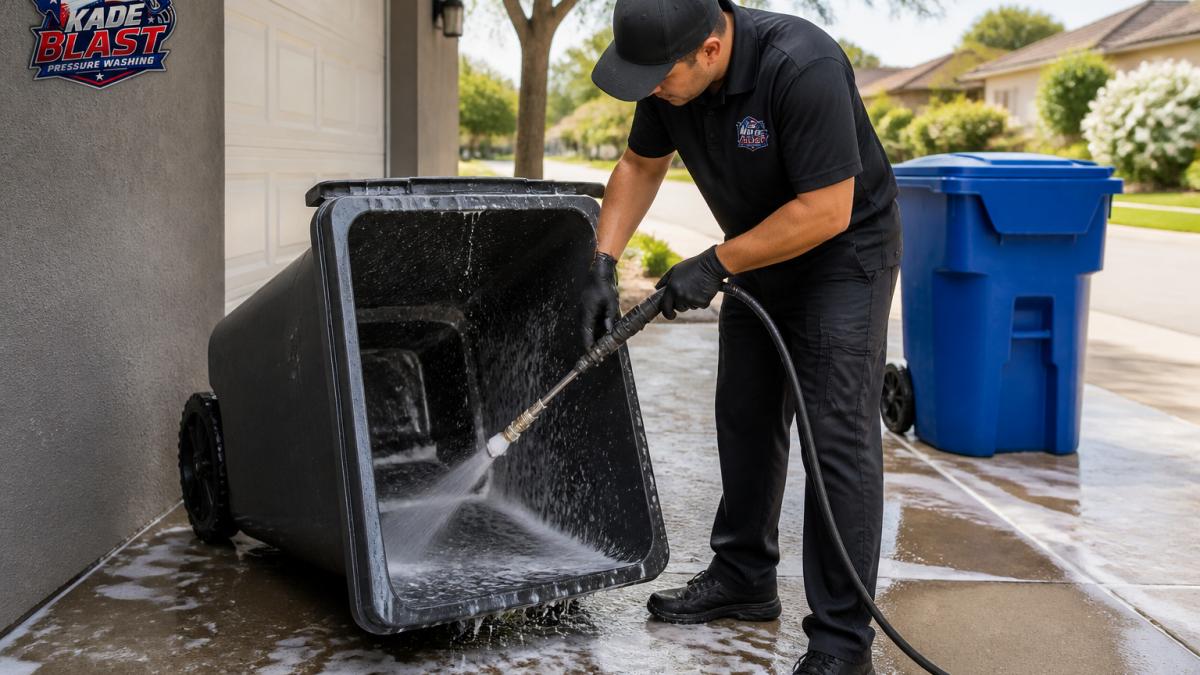
A full visit covers five stages: pre-rinse, hot-water pressure wash, sanitizing, deodorizing, and wastewater capture. The bin gets emptied of loose debris, washed inside and out with a high-pressure wand, treated with a sanitizing agent, then finished with a deodorizer. Lids and wheels get scrubbed by hand because the wand alone won't clear the hinge grime.
What separates a real clean from a rinse is dwell time. Sanitizer needs contact time on the surface to work, and a provider who sprays and immediately rinses is skipping the step that matters. If you want to understand how hot water, pressure, and sanitizers combine and what kill-rate claims actually mean, this guide on whether professional bin cleaning kills bacteria explains how to verify a provider's claims.
The other piece most people never ask about is wastewater. A responsible provider contains the runoff rather than letting it run into the storm drain. Ask where the water goes before you book.
How Often to Clean Trash Cans in Hot, Humid Weather
In hot, humid weather, clean your trash cans every two to four weeks. Heat accelerates bacterial growth and fly activity, and a bin that stays fresh for a month in mild weather can turn in ten days when the temperature holds above 90°F.
Households with young kids, pets, or a lot of food waste should lean toward the two-week end. Recycling bins need attention too, especially if they collect rinsed containers with residue in the corners. A common mistake is assuming recycling doesn't smell because it isn't garbage. It does.
Between professional visits, keep lids closed, bag food waste before it goes in, and rinse the bin's bottom on collection day. Pairing a cleaning schedule with fly deterrents works better than either alone, and this guide on how to keep flies away from trash covers the routines that actually hold up in warm weather.
Trash Bin Cleaning Plans and Pricing: Monthly, Quarterly, and One-Time
Plan names are standardized across the industry, but what each tier actually delivers varies by provider. Before you compare prices, understand what changes between tiers, usually frequency, per-visit rate, and billing cadence, not the cleaning process itself.
| Plan | Cleanings per year | Typical billing | Best for | Main trade-off |
|---|---|---|---|---|
| Monthly | 12 | Monthly auto-pay | Families, pet owners, hot climates, anyone with odor or pest history | Highest annual spend |
| Bi-monthly | 6 | Every other month | Average households with bagged food waste | Odor can return between visits in summer |
| Quarterly | 4 | Quarterly | Small households, low food waste, cool seasons | Buildup returns before the next visit |
| One-time | 1 | Single charge | Move-outs, post-renovation, inherited bins | No ongoing protection |
How to choose a frequency. Work through these five questions in order, the first one that describes your household sets your floor:
- Does the bin smell or draw flies within two weeks of cleaning? Go monthly. Odor that returns that fast means bacterial load is high and quarterly won't hold.
- Do you have pets, young children, or daily food waste in the bin? Lean monthly or bi-monthly. Pet waste and food scraps are the two heaviest odor drivers.
- Does summer heat hold above 90°F for weeks? Monthly in summer, quarterly in cool months is a common split. Ask whether the provider allows seasonal frequency changes without a new contract.
- Is your household small with mostly bagged, drained waste? Bi-monthly or quarterly is usually enough.
- Is this a one-time reset, a move-out, a renovation, a bin you inherited? Book one-time, then decide on a recurring plan after you see how long the clean lasts.
What changes between tiers, and what doesn't. What changes is how often it happens and the per-visit rate.
Billing cadence.
Choosing a frequency is really a question about your household, not your budget. If your bin smells by day ten, monthly is the honest answer.
What Monthly Service Includes and Leaves Out
Contract terms deserve a look. Find out the cancellation notice period, whether you can pause for a month, and what happens if the truck can't access your bins. A provider with clear terms will state them without being asked.
Choosing a Provider: Scheduling, Safety, and Wastewater Practices
Access matters too. Bins tucked behind a garage or in a tight side yard are normal, and a provider should confirm access requirements before the first visit so nobody shows up unable to reach the cans.
Booking Your First Bin Cleaning With Kade Blast Pressure Washing
Booking with us takes under a minute online, and you don't need to be home. We use commercial high-pressure equipment, specialized sanitizing agents, and eco-friendly deodorizers, and our process is fully contained with no mess left behind. Recurring monthly plans are also available.
If you want to see the results before you commit, browse the before-and-after photos of a real job. You can also explore more cleaning tips, guides and advice on our blog. Then pick a plan and let us take the worst chore on your list off it.
Frequently Asked Questions
How much does it cost to clean my trash can?
Most providers price by the bin, not by the hour, so your bill depends on how many containers you put out and how often you schedule service. Kade Blast publishes current rates on its pricing page, so check there for an exact quote on your first bin and each additional container before you book.
What is included in a monthly cleaning service?
A monthly visit covers a high-pressure wash, a sanitizing agent, and a deodorizer. Kade Blast's pricing page explains current options.
How often should trash cans be professionally cleaned?
In hot, humid climates, bins can develop odor and attract flies within a few weeks, especially with food waste. Households that compost or rarely put food in the bin can stretch to bi-monthly or quarterly. A good rule: if you can smell the bin from a few feet away or see flies around the lid, you waited too long. Match the frequency to how much organic waste your household generates.
Do I need to be home for a trash can cleaning service?
No. You can book and pay online in under a minute, and you do not need to be home for the service.
Your bins will never smell like a science experiment again. Get started with Kade Blast Pressure Washing and put your trash cans on a cleaning schedule that runs itself, backed by commercial-grade equipment, pet-safe deodorizers, and a 100% satisfaction guarantee.
